My sister called me the other day and told me about a situation she found herself in when she was with her 15-month-old daughter at the park.
As a mom, early childhood educator and parent coach who has spent decades working with families and kids, I knew what to tell her to help her navigate the next time she sees a child hitting another child.
My niece, who is 15 months old and just learning how to walk, was toddling around the playground full of other moms and kids.
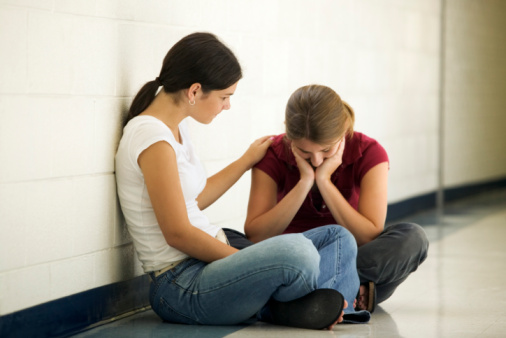
One of the older girls got mad, and as she stomped around, the older girl shoved my niece, knocking her off her feet and onto the ground. Ouch!
My sister, like so many parents I have worked with, was not sure what to do.
How are you supposed to respond when a child is hitting another child?
Do you correct other people’s children?
Do you try to protect the other kids from the upset child?
Situations like this are tough.
Being in a public setting makes things tougher… Kids and parents may not all know each other. And you can assume that parents at the playground likely have different parenting styles.
I walked her through these guidelines you can use to smoothly manage things the next time you see a child hitting another child (whether in public or in your own home).
Step 1 – Take stock of your own feelings
Seeing your child get pushed by another child will likely bring up some of your own feelings of concern, injustice, or even anger.
Before you say or do anything, take a pause to notice what feelings are present for you.
In the heat of the moment, it might be hard to take the time to notice and name your feelings; however this is an important step for responding consciously, rather than unconsciously reacting.
In Social Intelligence, Daniel Goleman says, “Naming for ourselves the emotions we feel can calm the amygdala… it affirms our capacity to reconsider knee jerk negative reactions to someone.”
It might feel difficult, or strange at first, but the more you practice this, the easier it becomes. It also only needs to take a few seconds.
Taking time to notice what is coming up for you allows you to think clearly and rationally, and your groundedness will support others to feel safer and less reactive too, which will help everything go more smoothly than if you give into that knee-jerk negative reaction you automatically have when witnessing a child hitting another child.
Step 2 – Reframe your judgments about the child hitting another child
In these situations, it’s also easy to fall into the trap of judging and labeling children as a “bully”, “victim”, “mean girl”, “good girl”, etc.
However, these types of labels are ultimately not very useful for understanding behavior and responding to kids to support their social development.
When I find myself labeling and judging others, I reframe it.
This is what Daniel Goleman calls “reappraisal” in his book Social Intelligence. He says, “by changing the meaning of what we see, we alter its emotional impact”.
Here are some of my favorite ways to reframe (or “reappraise”) a child’s behavior…
- “This is how kids learn to get along”
- “Anger is a cry for help”
- “Kids are always doing the best they can.”
I also reframe the situation by saying to myself, “This is the most important thing I’m going to do today” (this last one is from our conference interview with Dr. Laura Markham).
Step 3 – Respond To the Hurt Child
Starting with the child who was hit or pushed is usually a good place to start (unless the child who did the hitting is poised to hurt again, in which case, move to step 4, and then come back here.)
The first thing to know is that when comforting children our goal is attunement.
Attunement is a fancy word for seeking to understand your child, giving your total attention, and listening.
Daniel Goleman says that when we have a genuine connection with another person, we tune into their emotional state, rather than our own.
You may have lots of feelings if you find yourself in this situation (fear, shock, anger towards the other child), but responding to own child means paying attention to her feelings, rather than your own.
So what could attunement look like in “real life”?
If a child gets knocked down but doesn’t cry, she probably feels confused (“Why am I on the ground?”). You can say: “You didn’t expect that to happen” or “That was a surprise” and help her up.
If a child gets knocked down and is sad or angry about it, you can tune in to their sadness or anger by saying, “You didn’t want to be pushed!” or “You didn’t like that!” or “That hurt your head. Ouch!”.
The important point here is that in order for a child to feel understood, seen, and comforted, we tune into their feelings, rather than our own.
Step 4 – Protecting Other Kids
I, personally, feel really uncomfortable about correcting someone else’s child.
However, in order to keep everyone safe, I will step in if a child is not in control of themself and their own parent is too far away.
After being mindful of my feelings and reframing my judgments, I simply say to the child, “It’s ok to be mad, and I’m not going to let you push”.
I may even put my body between the child and others, if the situation warrants it, to protect other children.
It’s also a good idea to check in with the child’s parent. You can say, “I don’t know if you saw your child was having a hard time and pushed another child, so I told her, ‘It’s okay to be mad, and I’m not going to allow you to push others. ’ I hope that’s okay.”
Friendliness, understanding, and support towards other parents go a long way and help create the “village” that we all want for our kids.
Remember, that parent will have feelings, judgements, and insecurities spark automatically inside of themselves too, and creating an environment where they can sense your empathy and kindness for all involved eases tension and helps build connection.
Step 5 – Correcting the child who did the hitting
You might be thinking… But how will the other child learn not to push in the future?
Here’s something radical that came out in the child development research a few years ago… babies have an inborn sense of morality and justice, and even babies value helping over harming. This means that kids already know not to push, hit, kick, name-call, etc.
So, you might ask, if kids know hitting is wrong, why do they do it?
The reason kids hit, kick, or push is because they don’t know what else to do in the situation.
They’ve exhausted their options. They are at the “end of their rope”. And they don’t have the brain development to control their feelings or think up new ways to solve their problem.
This doesn’t mean that we as parents are helpless when kids hit, and that our only option is to wait for their brain to develop.
No way! We can help support kids’ brain and social development in many ways.
Now, if it wasn’t your child who did the hitting, then to some extent you will need to trust their caregiver to guide them further (See Step #4). However, with your child, you can use these moments as learning opportunities regardless of whether they were the one pushing or not.
One of the best ways to support kids’ brain development is to talk about the situation when they are calm.
You can ask what happened, how they felt about it, how the other child might have felt about it, and think of different ways they can solve their problem.